Christmas is now mere hours away. This means that if your shopping remains undone, you may be in trouble comparable to Arnie's in a festive classic. Mine is all safely done, wrapped and placed under the tree for my brother to poke at before opening (this is why I don't wrap them until Christmas Eve). This is probably a time for relaxation (unless you're making Christmas dinner): perhaps you'll go to Mass, perhaps you'll watch the Father Ted Christmas special (an annual tradition, since RTÉ are unimaginative), perhaps you'll watch some Yuletide film (Die Hard is the favourite, of course). Then again, perhaps you'll spend your time thinking about Christmas itself.
So ultimately, what does Christmas boil down to? The usual tabloid nonsense at this time of year about how Christmas is being stolen from Christianity is, of course, just that: complete nonsense. Christmas is not just about the birth of Jesus (let's face it, there's only a 1 in 365 chance it really is his birthday); it's about those great and elusive concepts of "peace" and "goodwill". In fairness, what could be more purely Christian than the spreading of goodwill towards all humanity? On that note, do everyone a favour this Christmas: if you happen to be out and about on Christmas Day, smile at people on the street, whether or not you know them, and wish them a merry Christmas. It's the best way to spread good cheer.
Now, while Christmas is about goodwill towards everyone, most people tend to associate it with family, which is entirely correct. Christmas is also a time for celebrating those we love and cherish. This is the point behind the giving of presents, and that cliché of "it's the thought that counts"; the surest sign imaginable that the present you have bought is God-awful. The point behind presents and indeed cards is to show that we appreciate those around us. It's also, of course, a time for friends; it may be nice to call in on some friends, if only for a few moments, on Christmas Day, or perhaps to give them a phone call. Nothing is so wonderful as an unsolicited call bearing only good wishes.
If you're working hard to prepare the house for visitors today, or else working on making dinner, it may be helpful to take a few moments to think about why exactly you're doing this, especially if you're feeling a little grumpy about it. It'll help a lot. Trust me; I just did – hence this post.
I'll take this opportunity to wish everyone who's reading this a very merry and safe Christmas. I do hope no-one is inconvenienced by the continuing inclement weather. I may post again in the next week, but if not, then I wish you all the best for 2011 as well.
[TEN AND A HALF HOURS UNTIL CHRISTMAS!]
24 December 2010

20 December 2010
Alternative Christmas Song No. 3
Silent Night – Jarvis Cocker, Lisa Hannigan and Richard Hawley
All right, the song itself isn't remotely alternative; it's the most famous of all Christmas carols. Even this version isn't terribly alternative – they don't even sing the second verse. It is, however, an utterly gorgeous version of the song, recorded recently for the Other Voices programme down in Dingle, Co. Kerry. The contrast between Hawley's stately, steady baritone and Hannigan's ethereal soprano is just magnificent; they should record an album together. Check out that slide guitar too.
[5 days until Christmas!]
All right, the song itself isn't remotely alternative; it's the most famous of all Christmas carols. Even this version isn't terribly alternative – they don't even sing the second verse. It is, however, an utterly gorgeous version of the song, recorded recently for the Other Voices programme down in Dingle, Co. Kerry. The contrast between Hawley's stately, steady baritone and Hannigan's ethereal soprano is just magnificent; they should record an album together. Check out that slide guitar too.
[5 days until Christmas!]
17 December 2010
A Most Seasonal Argument
At this time of year, there are many personalities who spring to mind: from the infant Christ (and indeed all the players in the Nativity story) and Father Christmas to George Bailey and, of course, John McClane. Yet there is one who is constantly misrepresented: Ebenezer Scrooge. He has appeared in many guises, played by (among others) Albert Finney, Michael Caine and Bill Murray (sort of). The sadly oft-forgotten fact is that, as those Muppet ladies sang, there is a sweet man inside; one who deserves to be recognised.
After all, Scrooge changes entirely by the end of A Christmas Carol. In fairness, this is not an easily-overlooked detail; the entire point of the book is that Scrooge changes his ways (partly because he's faced with eternal damnation, it must be said). In point of fact, Dickens tells us that: "Some people laughed to see the alteration in him, but he let them laugh, and little heeded them; for he was wise enough to know that nothing ever happened on this globe for good, at which some people did not have their fill of laughter in the outset". Presumably it is the descendants of these easily-amused folk who now think of Scrooge only as a mean-tempered miser. We're also told in the book's final paragraph that "[h]e had no further intercourse with Spirits", which is rather comforting (if a little troubling in its implications).
Despite Scrooge's change (he even sings; why yes, I am treating the Muppets version as definitive. Why not?), the idea of him is so bound up with the notion of miserliness that we even have adjectives such as "Scrooge-like"; he is the very form of mean-spiritedness, in the popular imagination. This can be seen, for example, in a recent Meteor ad, where the boss of the ad's protagonist (such as he is) is compared to Scrooge. Part of this probably comes from Dickens's propensity to attribute names to characters which seem to fit their character's personality; it must be said that the name "Scrooge" does sound more like a tight-fisted moneylender than a generous, kindly celebrant of Christmas.
The fact is that A Christmas Carol is very bound up with Christian notions of sin and (more importantly) redemption. Now, I'm not one of these people who is obsessed with the whole myth of "Winterval" and the secularisation of Christmas, you'll be pleased to hear. It is true, though, that society in general has become more secular since the publication of the book; it's not surprising, therefore, that it has acquired a different emphasis in the popular imagination. It remains a morality tale, of course, but it seems almost as though the focus has shifted to Scrooge as a "what not to do" type figure, rather than an ideal of redemption to aspire towards. This may not even be to do with secularism; maybe it's just a general pessimism in human nature. At any rate, though, it is at odds with the central idea of the book. Unless, of course, it's entirely inspired by the time Dickens met gaseous aliens with the Doctor, which is also entirely possible.
[8 days until Christmas!]
After all, Scrooge changes entirely by the end of A Christmas Carol. In fairness, this is not an easily-overlooked detail; the entire point of the book is that Scrooge changes his ways (partly because he's faced with eternal damnation, it must be said). In point of fact, Dickens tells us that: "Some people laughed to see the alteration in him, but he let them laugh, and little heeded them; for he was wise enough to know that nothing ever happened on this globe for good, at which some people did not have their fill of laughter in the outset". Presumably it is the descendants of these easily-amused folk who now think of Scrooge only as a mean-tempered miser. We're also told in the book's final paragraph that "[h]e had no further intercourse with Spirits", which is rather comforting (if a little troubling in its implications).
Despite Scrooge's change (he even sings; why yes, I am treating the Muppets version as definitive. Why not?), the idea of him is so bound up with the notion of miserliness that we even have adjectives such as "Scrooge-like"; he is the very form of mean-spiritedness, in the popular imagination. This can be seen, for example, in a recent Meteor ad, where the boss of the ad's protagonist (such as he is) is compared to Scrooge. Part of this probably comes from Dickens's propensity to attribute names to characters which seem to fit their character's personality; it must be said that the name "Scrooge" does sound more like a tight-fisted moneylender than a generous, kindly celebrant of Christmas.
The fact is that A Christmas Carol is very bound up with Christian notions of sin and (more importantly) redemption. Now, I'm not one of these people who is obsessed with the whole myth of "Winterval" and the secularisation of Christmas, you'll be pleased to hear. It is true, though, that society in general has become more secular since the publication of the book; it's not surprising, therefore, that it has acquired a different emphasis in the popular imagination. It remains a morality tale, of course, but it seems almost as though the focus has shifted to Scrooge as a "what not to do" type figure, rather than an ideal of redemption to aspire towards. This may not even be to do with secularism; maybe it's just a general pessimism in human nature. At any rate, though, it is at odds with the central idea of the book. Unless, of course, it's entirely inspired by the time Dickens met gaseous aliens with the Doctor, which is also entirely possible.
[8 days until Christmas!]
16 December 2010
Alas, Poor Country...
So, we're suffering through the post-Budget blues (there should be a song. Well, apart from this one). To make things worse, we've been buried in snow for the last couple of weeks, and there's more on the way. A general election is hovering tantalisingly out of reach. The economy may have just returned to growth, but at lower levels than expected. Overall, the country's in pretty bad shape, and everyone agrees. How nice, then, to see the BBC returning to old stereotypes in this article. What picture would best represent the state of Ireland's economy? Special offers on lager from SuperValu. Cheers, BBC. We appreciate your solidarity in this time of need. Want to slip in something about us blowing up pubs too while you're at it? Maybe something about Cromwell; I don't think that particular wound has been milked enough since the mid-17th century (yes, I know it's a mixed metaphor. Have you never milked a wound? You get some good blood).
Ah well. There's one thing that can help....
[9 days until Christmas!]
Ah well. There's one thing that can help....
[9 days until Christmas!]
12 December 2010
Alternative Christmas Song No. 2
'Christmas' – The Who
I spoke before, in my previous post on this subject, about songs that make us think of the needy at Christmas. Well, who could be needier than a deaf, dumb and blind child? This song is from the great 1969 album Tommy (and also the inferior 1975 Ken Russell film), and deals with how Tommy is so deprived, he doesn't even know about Christmas. This leads to the great refrain "Tommy, can you hear me?" (he can't, of course, but the father doesn't stop trying, bless his heart). The song also, incidentally, contains one of the random references to pinball ("playing poxy pinball...") that Pete Townshend inserted into the album at the last moment to gain the support of a prominent pinball-loving music critic (another was the whole song, 'Pinball Wizard', written in an afternoon and initially despised by Townshend, which became one of the band's biggest hits). Anyway, enough from me; click on the link, if you haven't already, and be entertained by Messrs. Daltrey, Townshend, Entwistle and Moon.
[13 days until Christmas!]
I spoke before, in my previous post on this subject, about songs that make us think of the needy at Christmas. Well, who could be needier than a deaf, dumb and blind child? This song is from the great 1969 album Tommy (and also the inferior 1975 Ken Russell film), and deals with how Tommy is so deprived, he doesn't even know about Christmas. This leads to the great refrain "Tommy, can you hear me?" (he can't, of course, but the father doesn't stop trying, bless his heart). The song also, incidentally, contains one of the random references to pinball ("playing poxy pinball...") that Pete Townshend inserted into the album at the last moment to gain the support of a prominent pinball-loving music critic (another was the whole song, 'Pinball Wizard', written in an afternoon and initially despised by Townshend, which became one of the band's biggest hits). Anyway, enough from me; click on the link, if you haven't already, and be entertained by Messrs. Daltrey, Townshend, Entwistle and Moon.
[13 days until Christmas!]
07 December 2010
A Close Encounter with Genius
On Sunday the 5th of December 2010, a date that will live in fame, I saw Arcade Fire live in Dublin for the second time in my life. I could use words like "incandescent" or "transcendental" to describe the experience, and I probably will. The fact is that it was nothing more or less than the best concert of any kind to which I've ever been. Its closest competitor? The last time they played here in October 2007, in the Phoenix Park.
For such a cold day, the journey there was easy enough, thanks to the Luas. I arrived at the O2 midway through Devendra Banhart's set, which I was actually rather sorry I missed; I understand it was worth seeing. Vampire Weekend were the other support band; they put on a fairly decent show, although I wasn't quite as enamoured with them as other people seemed to be. My first thought when the Sultans of Sound themselves came on stage was that Vampire Weekend were probably weeping backstage, suffering by comparison. In fairness, just about anyone would have been.
That brings me on rather neatly to Arcade Fire's own set. I thought the setlist was ideal; about half of The Suburbs, three from Neon Bible ('Keep the Car Running', 'Intervention' and 'No Cars Go') and seven from Funeral (including my favourite Arcade Fire song of all, 'Crown of Love'). The set as a whole was about 100 minutes long, which was more or less ideal; there were a couple of notable absentees from the setlist, but it would a bit ungrateful to complain about that after an absolute blinder of a concert. The songs bled into each other beautifully; a particular highlight was when 'Neighbourhood #3 (Power Out)' segued into 'Rebellion (Lies)' via a sonic assault of which Iggy Pop would have been proud.
This same sonic assault was backed up by a remarkable level of energy among the band members. Will Butler was particularly insane, often spending whole songs banging a snare drum which wasn't miced up (he was, at least, in time). Meanwhile, when Régine Chassagne was on lead vocal duties (notably during particular highlight 'Sprawl II (Mountains Beyond Mountains)'), she danced elegantly around the stage, resembling nothing so much as a child at play. As for Win Butler, he made an effort to rival his brother and wife, often coming right up to the audience (unlike the last time, he didn't do a stage dive; it's rarely a good idea when you're six-and-a-half feet tall). As usual, the band seamlessly swapped instruments throughout the show; I shudder to think how much rehearsal time must have been necessary to pull off such a feat.
I've always been impressed with the sound quality in the O2, and Sunday was no different. In fact, it was probably the best quality of sound I've ever heard there, which is saying something. Every note was clear, crisp and, not least, loud. In addition to this, the show had an excellent visual component. Cameramen at the sides of the stage captured live images of the band, sometimes focusing on individual members, sometimes providing a wider picture. Whoever was controlling these images did a fantastic job, particularly when they started playing around with opacity so that band members appeared to pass through one another.
In short, the show was both incandescent and transcendental (see?). I spoke to a number of friends about it afterwards. Some had seen the band live before; others hadn't. All were in agreement that the concert had been remarkable, and one of the best they'd ever been to. I've been listening to almost nothing but Arcade Fire for the last two days. My love for them had, I confess, lapsed a little in the last couple of years, but it has been reawakened with a vengeance now. Arcade Fire are coming for YOU. You should be glad of it.
Oh, incidentally, if you have Google Chrome, open it up (if it's not already open) and go to www.thewildernessdowntown.com. It's quite something.
[18 days until Christmas!]
For such a cold day, the journey there was easy enough, thanks to the Luas. I arrived at the O2 midway through Devendra Banhart's set, which I was actually rather sorry I missed; I understand it was worth seeing. Vampire Weekend were the other support band; they put on a fairly decent show, although I wasn't quite as enamoured with them as other people seemed to be. My first thought when the Sultans of Sound themselves came on stage was that Vampire Weekend were probably weeping backstage, suffering by comparison. In fairness, just about anyone would have been.
That brings me on rather neatly to Arcade Fire's own set. I thought the setlist was ideal; about half of The Suburbs, three from Neon Bible ('Keep the Car Running', 'Intervention' and 'No Cars Go') and seven from Funeral (including my favourite Arcade Fire song of all, 'Crown of Love'). The set as a whole was about 100 minutes long, which was more or less ideal; there were a couple of notable absentees from the setlist, but it would a bit ungrateful to complain about that after an absolute blinder of a concert. The songs bled into each other beautifully; a particular highlight was when 'Neighbourhood #3 (Power Out)' segued into 'Rebellion (Lies)' via a sonic assault of which Iggy Pop would have been proud.
This same sonic assault was backed up by a remarkable level of energy among the band members. Will Butler was particularly insane, often spending whole songs banging a snare drum which wasn't miced up (he was, at least, in time). Meanwhile, when Régine Chassagne was on lead vocal duties (notably during particular highlight 'Sprawl II (Mountains Beyond Mountains)'), she danced elegantly around the stage, resembling nothing so much as a child at play. As for Win Butler, he made an effort to rival his brother and wife, often coming right up to the audience (unlike the last time, he didn't do a stage dive; it's rarely a good idea when you're six-and-a-half feet tall). As usual, the band seamlessly swapped instruments throughout the show; I shudder to think how much rehearsal time must have been necessary to pull off such a feat.
I've always been impressed with the sound quality in the O2, and Sunday was no different. In fact, it was probably the best quality of sound I've ever heard there, which is saying something. Every note was clear, crisp and, not least, loud. In addition to this, the show had an excellent visual component. Cameramen at the sides of the stage captured live images of the band, sometimes focusing on individual members, sometimes providing a wider picture. Whoever was controlling these images did a fantastic job, particularly when they started playing around with opacity so that band members appeared to pass through one another.
In short, the show was both incandescent and transcendental (see?). I spoke to a number of friends about it afterwards. Some had seen the band live before; others hadn't. All were in agreement that the concert had been remarkable, and one of the best they'd ever been to. I've been listening to almost nothing but Arcade Fire for the last two days. My love for them had, I confess, lapsed a little in the last couple of years, but it has been reawakened with a vengeance now. Arcade Fire are coming for YOU. You should be glad of it.
Oh, incidentally, if you have Google Chrome, open it up (if it's not already open) and go to www.thewildernessdowntown.com. It's quite something.
[18 days until Christmas!]
04 December 2010
Seasonal Entertainment
As it's that time of year again, and I did mention before that I'd be doing an article to do with Christmas songs, I present to you my analysis of some of the most notable ones, and particularly their videos. There are some notable exceptions: some of them just don't have much to comment on, which is why Slade, for instance, escape comment. I mentioned before that I might do an article on Ronan Keating and Moya Brennan's travesty of a cover of 'Fairytale of New York'; it didn't occur to me that that would involve having to actually listen to the bloody thing. Same goes for 'Christmas Shoes' (I actually turned off the radio yesterday when I heard that muckheap of a song coming on). As such, neither of these hideous Antichrists of songs will be getting a write-up here.
I'll start with one of the usual suspects: Wizzard's 'I Wish It Could Be Christmas Every Day'. Now, I should point out that I'm physically incapable of disliking this song; it's rare for me to describe a song as "fun", but such is the case with this one. I only realised recently what a brilliant line "When the snowman brings the snow" is (which is presumably why it's repeated ad infinitum). Nonetheless, there are a few things that always strike me about the video. First of all, have a look at the bass player. It would seem that, having saved Middle-Earth, Legolas decided to grow a beard and join a mid-70s band. According to Wikipedia, he also changed his name to Rick Price. Next, have a look at the drummer at the front (the one with the magnificent hair). For some reason, I always wonder if he's a distant cousin of Ringo Starr; something in the gaze, I daresay. He also does a wonderful Harpo Marx impression around the 0.50 mark. Third in my series of band members is the pianist. Now, this fellow doesn't appear on camera for most of the video, but when he does, it's immediately apparent why. Stop reading this, and have a look at 1.20 in the video. Then come back. Done that? Good. Now you'll know what I mean when I ask WHAT ON EARTH IS GOING ON?! He genuinely scares me. Every time I watch this video, I question why on Earth he was allowed near children. According to Wiki, again, he left the band soon after, which really worries me. Of course, Roy Wood demands a kiss off a small girl at 4.05, but that's nice and innocent, even if he does attempt to kick her a few seconds later.
Next, another favourite of mine: 'Stop the Cavalry', by Jona Lewie. Not nearly enough Christmas songs start with a bugle. Like Waits's 'Christmas Card...', it's a nicely poignant song. There's one aspect of the video that's always mildly distressed me, though. The video cuts between Jona Lewie out on the battlefield singing his heart out, and Miss Mary Bradley sitting at home waiting for him. At 1.45, though, he apparently gets shot... and we never see him again. Of course, he has just rather foolishly said "If I get home, live to tell the tale", which is asking for trouble. Still, though, I would rather like to assume he survives the war; that's a mildly depressing thought for Christmas.
Actually, there was a whole series of depressing songs on The Daily Dish last year; I submitted 'Fairytale of New York' (please try to ignore the stupid, adversarial "Think this is bad? Look at MY submission!" tone of my e-mail), which a lot of readers disagreed with, saying the song was really about two people staying together no matter what. I actually agreed with that; I just wanted to open up the song to a wider American audience. Someone also submitted 'Christmas Card...' – good for them. I believe there was also a post on the incredibly depressing original lyrics of 'Have Yourself A Merry Little Christmas' (which, unfortunately, I can't seem to find); here's the Wiki on the subject, though.
On a less depressing note, we have 'Little Drummer Boy/Peace on Earth'. Now, this song has recently been covered by The Priests and Shane MacGowan. That said, their version seems to mainly consist of The Priests singing both parts of the song while Shane mumbles in the background and (from 2.05 onwards) gets held up by two of the fathers. The more famous version, of course, is by Bing Crosby and David Bowie, recorded in 1977, only a month before Crosby's death. My sister likes to complain about this video, since the two talk about Christmas until 1.50; almost half the video. I also rather love the description on this particular video; it seems that the two really didn't know anything about each other. Maybe all that talking wasn't scripted?
Bowie mentions John Lennon in that video, which brings me neatly on to Paul McCartney (look at me segue!). I haven't much to say about 'Wonderful Christmas Time', especially as I've never really thought much of it. I much prefer Peter Serafinowicz's 'Sexual Christmas Time', which I would rather like to be released this year. Listen to the two back-to-back; it's educational. Anyway, the song I really wanted to discuss is 'Pipes of Peace'. I'm guessing the first 20 seconds of this video are the result of Paul having been owed a favour by the Doctor Who sound effects team. The video deals with the Christmas Truce of 1914, when German and British soldiers stopped fighting to sing carols and play football. Unfortunately, the truce was unofficial and short-lived; it didn't outlast Christmas Day in most parts of the Western Front, and it didn't even occur in a lot of places. Of course, according to Sir Paul, it actually lasted about a minute (though that may be just to cut down on having to have two versions of him onscreen for too long).
Christmas tends to be associated with dodgy woollen jumpers, particularly among fans of the Late Late Toy Show. One of the finest examples I've ever seen is in the video for Shakin' Stevens's 'Merry Christmas Everyone', which appears to be of stars and... some kind of red explosion? The video also features a rather frightening Santa, who can glimpsed at 0.50. I'm not entirely convinced he has a face. He also appears to use child labour; they may look like they're playing, but he also appears to be showing them how to manufacture toys in the correct manner. To top all this off, there's the creature (woman? Elf? Zombie?) riding in the sleigh with our friend Shakin'. She gazes wistfully around, smiling blankly, but we know she's weeping inside.
Now we come to my dear friend Cliff Richard. If any of you have the misfortune to have a copy of his calendar in your home every year, you will understand my pain. As such, it's always very enticing to see him wandering around at the edge of a cliff (ho ho! Cliff! Do you get it?) in the video for 'Saviour's Day'. No matter how many times I see it, I always think "Maybe this time he'll fall. Just maybe..." Optimism is a wonderful thing. His gesturing is top-notch as ever in this video; lots of clenched fists and fingers being pointed skywards. Added to this, yet again some poor children are forced to be in a video for a Christmas song. These ones have to stand around in cold sea winds while a middle-aged man prances around. I bet he was patronising towards them too. He seems the sort.
This brings me neatly on to the king of all dodgy Christmas videos. Are you sitting comfortably? Then I'll begin...
Let's not mince words: 'Mistletoe and Wine' is an awful song. It's played in pubs at closing time to get people out. The video, though, completely makes up for that in its comedy value. It begins with Cliff standing outside a small child's bedroom window: interesting. I really can't make paedophile jokes about Cliff, though (although Chris Morris probably could); he just seems too asexual (though, according to The Day Today, he did once become pregnant). At 1.15, he seems to imply that he's being controlled by the Master, through the odd medium of a small candle. Next comes one of the finest freeze-frames in history, at 1.38, where Cliff does a brief Fonzie pose before passing between the two groups of carollers. Ridiculously fake-looking snow starts to fall on old-fashioned tin soldiers come to life, and Cliff moves back towards the camera for some more posing. 2.17 is another fine freeze-frame, where Cliff briefly ponders a career as a professional boxer. A gong is bashed, and the real genius ensues. From 2.25, Cliff is in the background, presumably so that he doesn't damage any filming equipment as he swings his arms (and his entire weight) from side to side. The choir are a few paces behind him, presumably so that they aren't damaged. Around 2.35, Cliff almost overbalances a couple of times, and decides to cut down on his dancing. Another wonderful freeze-frame comes at 2.52, as he tries to act cool as the soldiers pass him. For the last minute or so, Cliff tries to make himself warm. Finally, at 3.45, the small child from the beginning has come outside to stop the scary man and his choir from singing while she's trying to sleep. The scary man responds by waving in a disturbing manner.
I daresay that's about it. Why yes, I HAVE seen these videos far too many times. Still, they entertain me every year; I enjoy expanding on these various comments I have, which I've built up over several Christmases. Yet another thing I love about Christmas, then.
[21 days until Christmas!]
I'll start with one of the usual suspects: Wizzard's 'I Wish It Could Be Christmas Every Day'. Now, I should point out that I'm physically incapable of disliking this song; it's rare for me to describe a song as "fun", but such is the case with this one. I only realised recently what a brilliant line "When the snowman brings the snow" is (which is presumably why it's repeated ad infinitum). Nonetheless, there are a few things that always strike me about the video. First of all, have a look at the bass player. It would seem that, having saved Middle-Earth, Legolas decided to grow a beard and join a mid-70s band. According to Wikipedia, he also changed his name to Rick Price. Next, have a look at the drummer at the front (the one with the magnificent hair). For some reason, I always wonder if he's a distant cousin of Ringo Starr; something in the gaze, I daresay. He also does a wonderful Harpo Marx impression around the 0.50 mark. Third in my series of band members is the pianist. Now, this fellow doesn't appear on camera for most of the video, but when he does, it's immediately apparent why. Stop reading this, and have a look at 1.20 in the video. Then come back. Done that? Good. Now you'll know what I mean when I ask WHAT ON EARTH IS GOING ON?! He genuinely scares me. Every time I watch this video, I question why on Earth he was allowed near children. According to Wiki, again, he left the band soon after, which really worries me. Of course, Roy Wood demands a kiss off a small girl at 4.05, but that's nice and innocent, even if he does attempt to kick her a few seconds later.
Next, another favourite of mine: 'Stop the Cavalry', by Jona Lewie. Not nearly enough Christmas songs start with a bugle. Like Waits's 'Christmas Card...', it's a nicely poignant song. There's one aspect of the video that's always mildly distressed me, though. The video cuts between Jona Lewie out on the battlefield singing his heart out, and Miss Mary Bradley sitting at home waiting for him. At 1.45, though, he apparently gets shot... and we never see him again. Of course, he has just rather foolishly said "If I get home, live to tell the tale", which is asking for trouble. Still, though, I would rather like to assume he survives the war; that's a mildly depressing thought for Christmas.
Actually, there was a whole series of depressing songs on The Daily Dish last year; I submitted 'Fairytale of New York' (please try to ignore the stupid, adversarial "Think this is bad? Look at MY submission!" tone of my e-mail), which a lot of readers disagreed with, saying the song was really about two people staying together no matter what. I actually agreed with that; I just wanted to open up the song to a wider American audience. Someone also submitted 'Christmas Card...' – good for them. I believe there was also a post on the incredibly depressing original lyrics of 'Have Yourself A Merry Little Christmas' (which, unfortunately, I can't seem to find); here's the Wiki on the subject, though.
On a less depressing note, we have 'Little Drummer Boy/Peace on Earth'. Now, this song has recently been covered by The Priests and Shane MacGowan. That said, their version seems to mainly consist of The Priests singing both parts of the song while Shane mumbles in the background and (from 2.05 onwards) gets held up by two of the fathers. The more famous version, of course, is by Bing Crosby and David Bowie, recorded in 1977, only a month before Crosby's death. My sister likes to complain about this video, since the two talk about Christmas until 1.50; almost half the video. I also rather love the description on this particular video; it seems that the two really didn't know anything about each other. Maybe all that talking wasn't scripted?
Bowie mentions John Lennon in that video, which brings me neatly on to Paul McCartney (look at me segue!). I haven't much to say about 'Wonderful Christmas Time', especially as I've never really thought much of it. I much prefer Peter Serafinowicz's 'Sexual Christmas Time', which I would rather like to be released this year. Listen to the two back-to-back; it's educational. Anyway, the song I really wanted to discuss is 'Pipes of Peace'. I'm guessing the first 20 seconds of this video are the result of Paul having been owed a favour by the Doctor Who sound effects team. The video deals with the Christmas Truce of 1914, when German and British soldiers stopped fighting to sing carols and play football. Unfortunately, the truce was unofficial and short-lived; it didn't outlast Christmas Day in most parts of the Western Front, and it didn't even occur in a lot of places. Of course, according to Sir Paul, it actually lasted about a minute (though that may be just to cut down on having to have two versions of him onscreen for too long).
Christmas tends to be associated with dodgy woollen jumpers, particularly among fans of the Late Late Toy Show. One of the finest examples I've ever seen is in the video for Shakin' Stevens's 'Merry Christmas Everyone', which appears to be of stars and... some kind of red explosion? The video also features a rather frightening Santa, who can glimpsed at 0.50. I'm not entirely convinced he has a face. He also appears to use child labour; they may look like they're playing, but he also appears to be showing them how to manufacture toys in the correct manner. To top all this off, there's the creature (woman? Elf? Zombie?) riding in the sleigh with our friend Shakin'. She gazes wistfully around, smiling blankly, but we know she's weeping inside.
Now we come to my dear friend Cliff Richard. If any of you have the misfortune to have a copy of his calendar in your home every year, you will understand my pain. As such, it's always very enticing to see him wandering around at the edge of a cliff (ho ho! Cliff! Do you get it?) in the video for 'Saviour's Day'. No matter how many times I see it, I always think "Maybe this time he'll fall. Just maybe..." Optimism is a wonderful thing. His gesturing is top-notch as ever in this video; lots of clenched fists and fingers being pointed skywards. Added to this, yet again some poor children are forced to be in a video for a Christmas song. These ones have to stand around in cold sea winds while a middle-aged man prances around. I bet he was patronising towards them too. He seems the sort.
This brings me neatly on to the king of all dodgy Christmas videos. Are you sitting comfortably? Then I'll begin...
Let's not mince words: 'Mistletoe and Wine' is an awful song. It's played in pubs at closing time to get people out. The video, though, completely makes up for that in its comedy value. It begins with Cliff standing outside a small child's bedroom window: interesting. I really can't make paedophile jokes about Cliff, though (although Chris Morris probably could); he just seems too asexual (though, according to The Day Today, he did once become pregnant). At 1.15, he seems to imply that he's being controlled by the Master, through the odd medium of a small candle. Next comes one of the finest freeze-frames in history, at 1.38, where Cliff does a brief Fonzie pose before passing between the two groups of carollers. Ridiculously fake-looking snow starts to fall on old-fashioned tin soldiers come to life, and Cliff moves back towards the camera for some more posing. 2.17 is another fine freeze-frame, where Cliff briefly ponders a career as a professional boxer. A gong is bashed, and the real genius ensues. From 2.25, Cliff is in the background, presumably so that he doesn't damage any filming equipment as he swings his arms (and his entire weight) from side to side. The choir are a few paces behind him, presumably so that they aren't damaged. Around 2.35, Cliff almost overbalances a couple of times, and decides to cut down on his dancing. Another wonderful freeze-frame comes at 2.52, as he tries to act cool as the soldiers pass him. For the last minute or so, Cliff tries to make himself warm. Finally, at 3.45, the small child from the beginning has come outside to stop the scary man and his choir from singing while she's trying to sleep. The scary man responds by waving in a disturbing manner.
I daresay that's about it. Why yes, I HAVE seen these videos far too many times. Still, they entertain me every year; I enjoy expanding on these various comments I have, which I've built up over several Christmases. Yet another thing I love about Christmas, then.
[21 days until Christmas!]
01 December 2010
Alternative Christmas Song No. 1
As it's the 1st of December and the Christmas season has officially started, I thought I'd mark the occasion by beginning a new series. As previously intimated, I rather like Christmas music, so this will be dedicated to those Christmas songs that lie just off the beaten track. I'll start with a personal favourite:
Christmas Card from a Hooker in Minneapolis – Tom Waits (this version also has Waits singing Silent Night; always a bonus)
As I always mention when this song is brought up, a few years back, when downloads started being taken into account for the charts, there was a campaign to make this Christmas Number One. Sadly, it didn't pan out; I'd have loved to hear radio stations forced to play this. This song is perhaps even more poignant than Fairytale of New York. Ignore the insipid crap of Band Aid; if you want to think about those less fortunate, this is the song to go for.
[24 days until Christmas!]
Christmas Card from a Hooker in Minneapolis – Tom Waits (this version also has Waits singing Silent Night; always a bonus)
As I always mention when this song is brought up, a few years back, when downloads started being taken into account for the charts, there was a campaign to make this Christmas Number One. Sadly, it didn't pan out; I'd have loved to hear radio stations forced to play this. This song is perhaps even more poignant than Fairytale of New York. Ignore the insipid crap of Band Aid; if you want to think about those less fortunate, this is the song to go for.
[24 days until Christmas!]
27 November 2010
The Weather Outside...
I awoke this morning to a silent and empty house (mildly disturbing in itself), only to find, upon gazing out the window, that the forecast snow had arrived, a possibility which I had come to disbelieve given the relatively mild temperature when I was on my way home several hours before. Now, at the time I was rather pleased; a quiet suburban road swathed in snow is a rather beautiful sight. Now, however, having spent a good portion of the day making my way through this snow, I'm rather less pleased about it.
The reasons for this are myriad. First, there is the fact that when going into college (as I was today), I have to spend at least a couple of hours in transit, sitting on or waiting for buses. Today, thanks to the snow (which caused lesser roads to be slippery and necessitated diversions on some routes) and a large march in the city centre (another topic on which I had a good grumble to myself), that time was drastically increased. In fairness, buses are generally less frequent on a Saturday anyway, and I was relying on a notoriously unreliable route. Still, much annoyance was had.
Even more annoying than the buses were the brats throwing snowballs at them. I was very much hoping that there would be some just before my stop, so I could walk towards them looking threatening in my long black coat. Sadly, the only snowballing brats I came across were in the middle of my route (of course, a scarcity of them is nothing to complain about, in the same way that I was oddly muted about the lack of fireworks – which I despise – this Hallowe'en). I did come across one other snowball fight on my walk from the bus stop to my house, but this one was between two groups of children and actually looked more innocent than aggressive. In fact, it looked so fun that it brought a smile to my face.
I rather thought that if snow arrived, it would make me feel Christmassy. In fact, it just made me feel very cold indeed. I associate snow more with January or February than Christmas (though I've known a couple of white Christmases). Standing at bus stops for an extended period of time did help much with the cold. Then again, it's been very cold for quite some time now, so I can hardly blame that on the snow.
That said, of course, my mood can be easily improved. For one thing, I've written my letter to Santa. Some people were rather surprised at the persistence of this tradition within my family, but it makes perfect sense. This way, we know what to get each other, which is especially valuable given that my siblings and I now live under three separate roofs. I also enjoy myself every year writing an unnecessarily pompous letter. This year, for instance, I said "I am aware that, in your omniscience, you are probably already cognisant of this fact, yet I feel it incumbent upon me to make reference to the fact, lest your godlike perception should be failing" rather than "You probably already know this, but I thought I'd tell you anyway".
Despite all this Scrooging, I should point out that I don't actually hate snow (Dino will back me up). At the very beginning of this year, I walked home from a friend's house through quite a deep snowfall at about three in the morning. The journey was about twenty minutes, and I hardly saw a soul in all that time. It's a simple thing, but it was one of the most peaceful and lovely experiences of my life, and a large part of that was down to the strange silence which the snow somehow emphasised ("Never knew such silence. The earth might be uninhabited."). Even if this cold persists, I can always find ways to improve my mood.
And if all else fails...
[28 days until Christmas!]
The reasons for this are myriad. First, there is the fact that when going into college (as I was today), I have to spend at least a couple of hours in transit, sitting on or waiting for buses. Today, thanks to the snow (which caused lesser roads to be slippery and necessitated diversions on some routes) and a large march in the city centre (another topic on which I had a good grumble to myself), that time was drastically increased. In fairness, buses are generally less frequent on a Saturday anyway, and I was relying on a notoriously unreliable route. Still, much annoyance was had.
Even more annoying than the buses were the brats throwing snowballs at them. I was very much hoping that there would be some just before my stop, so I could walk towards them looking threatening in my long black coat. Sadly, the only snowballing brats I came across were in the middle of my route (of course, a scarcity of them is nothing to complain about, in the same way that I was oddly muted about the lack of fireworks – which I despise – this Hallowe'en). I did come across one other snowball fight on my walk from the bus stop to my house, but this one was between two groups of children and actually looked more innocent than aggressive. In fact, it looked so fun that it brought a smile to my face.
I rather thought that if snow arrived, it would make me feel Christmassy. In fact, it just made me feel very cold indeed. I associate snow more with January or February than Christmas (though I've known a couple of white Christmases). Standing at bus stops for an extended period of time did help much with the cold. Then again, it's been very cold for quite some time now, so I can hardly blame that on the snow.
That said, of course, my mood can be easily improved. For one thing, I've written my letter to Santa. Some people were rather surprised at the persistence of this tradition within my family, but it makes perfect sense. This way, we know what to get each other, which is especially valuable given that my siblings and I now live under three separate roofs. I also enjoy myself every year writing an unnecessarily pompous letter. This year, for instance, I said "I am aware that, in your omniscience, you are probably already cognisant of this fact, yet I feel it incumbent upon me to make reference to the fact, lest your godlike perception should be failing" rather than "You probably already know this, but I thought I'd tell you anyway".
Despite all this Scrooging, I should point out that I don't actually hate snow (Dino will back me up). At the very beginning of this year, I walked home from a friend's house through quite a deep snowfall at about three in the morning. The journey was about twenty minutes, and I hardly saw a soul in all that time. It's a simple thing, but it was one of the most peaceful and lovely experiences of my life, and a large part of that was down to the strange silence which the snow somehow emphasised ("Never knew such silence. The earth might be uninhabited."). Even if this cold persists, I can always find ways to improve my mood.
And if all else fails...
[28 days until Christmas!]
19 November 2010
The Return of Christmas
Another misleading post title, then. I'm not talking about the return of the Christmas season, which in fact I've covered previously (and will almost certainly cover again), but the return of Christmas to WAKE UP itself (not that it ever really went away). In doing so, I'd like to introduce what's essentially the first ever guest post on WAKE UP, which will take a rather unusual form. It's not so much a post, actually, as a screenplay by my good friend Saoirse; she decided to write a Christmas film, and this is what she came up with. It's rather short, of course, but I prefer to think of it as perfectly-formed; really, you don't need any more than this.
1. INT. SANTA'S OFFICE. DAY.
SANTA'S office is lovely. It looks like Christmas exploded and is dripping off the walls. Everything is all...nice. SANTA is checking the naughty-nice list.
You may invent your own ending; I rather like the one where Santa initiates divorce proceedings against his wife, and they have heated courtroom battles over who gets custody of the elves.
[ 36 days until Christmas!]
'Holy Shit, Christmas'
By
Saoirse Ní Chiaragáin
1. INT. SANTA'S OFFICE. DAY.
SANTA'S office is lovely. It looks like Christmas exploded and is dripping off the walls. Everything is all...nice. SANTA is checking the naughty-nice list.
SANTA
Oh everyone is so nice! This
makes my job so goddamn easy!
Suddenly, he gasps with horror. His hands shake and he drops the list. SANTA
No...no...Jesus Christ, NO!
NOOOOOOOOOOOOOOOOOO.
We see that MRS. CLAUS has been listed as naughty. Holy shit. You may invent your own ending; I rather like the one where Santa initiates divorce proceedings against his wife, and they have heated courtroom battles over who gets custody of the elves.
[ 36 days until Christmas!]
11 November 2010
Tales of Woe
The more perceptive among you may notice that the look of this post is rather different. The reason for this is that I'm writing it in a different format to usual. The reason for this in turn is that I'm not writing this on my laptop, which I'm unable to use at the present time, since the charger exploded in my face a few days ago, which was quite a sight. This is also the reason why there hasn't been much activity on the WAKE UP front for a little bit of time now. I haven't forgotten about you all, though; the reason for this post is partly to assure the Internet at large of that.
The other purpose behind this post is to apologise in advance if posting more or less grinds to a halt for a little while, as I'm rather swamped with work at the moment. The only posts I would be able to produce would inevitably be on subjects such as the portrayal of death in the work of Martin McDonagh: fascinating to me, but probably not to the general public. As such, you may have to excuse me from blogging duties for a short while.
Lest I fail to mention it in the next couple of weeks, I shall also be attending the O2, Dublin on the 5th of December, when the Almighty Arcade Fire shall be gracing we humble Dubliners with Their august presence. It is my earnest hope that all those reading these words shall also better themselves by attending either this great event, or another like it, so as to absorb the splendour of Arcade Fire into their lives.
[44 days until Christmas!]
The other purpose behind this post is to apologise in advance if posting more or less grinds to a halt for a little while, as I'm rather swamped with work at the moment. The only posts I would be able to produce would inevitably be on subjects such as the portrayal of death in the work of Martin McDonagh: fascinating to me, but probably not to the general public. As such, you may have to excuse me from blogging duties for a short while.
Lest I fail to mention it in the next couple of weeks, I shall also be attending the O2, Dublin on the 5th of December, when the Almighty Arcade Fire shall be gracing we humble Dubliners with Their august presence. It is my earnest hope that all those reading these words shall also better themselves by attending either this great event, or another like it, so as to absorb the splendour of Arcade Fire into their lives.
[44 days until Christmas!]
01 November 2010
Correct Priorities
As you may know, over the weekend Jon Stewart and Stephen Colbert held their "Rally for Sanity" in Washington DC. The rally was, by all accounts, a great success, and indeed reasonably sane, which is reassuring. It also provided much in the way of clever satirical signs and placards, which are well worth looking up (here, for instance). The one that caught my eye, though, was this one, for obvious reasons.
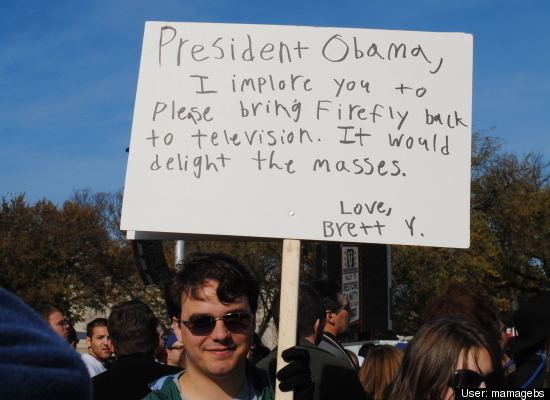
I suggest that this gentleman has his priorities right: he can see for what the unequalled power of the office of POTUS should be used. I salute the gentleman in the picture, and suggest that, should his appeal to Mr. Obama fail, he move on to other world leaders. I feel certain that he would be able to start at least a medium-sized protest in France, whether or not the people involved had even heard of Firefly.
[54 days until Christmas!]
24 October 2010
Further Regeneration
A most momentous event has occurred. Mere moments ago, I checked my e-mail account, only to find that I had received an e-mail from one "Derek Young", co-creator of WAKE UP. That e-mail concerned this very blog; it seems that Derek is interested in returning to the fold very soon. This will presumably mean less of me wittering on about the creations of Joss Whedon, which is probably a good thing.
Moreover, Derek raised an interesting point: I have not commented on "the latest offering from the temple of the Great Arcade Fire" yet. Fear not, friends; I have heard 'The Suburbs' and do, in fact, still exist. In addition to this, I admire the album greatly; I don't think it quite reaches the giddy heights of 'Funeral', but it may well surpass 'Neon Bible', which is not a statement I make lightly. I hope that this will prove my continued existence and loyalty to those Monarchs of Montreal, those Queens (and Kings) of Quebec.
(62 days until Christmas!)
Moreover, Derek raised an interesting point: I have not commented on "the latest offering from the temple of the Great Arcade Fire" yet. Fear not, friends; I have heard 'The Suburbs' and do, in fact, still exist. In addition to this, I admire the album greatly; I don't think it quite reaches the giddy heights of 'Funeral', but it may well surpass 'Neon Bible', which is not a statement I make lightly. I hope that this will prove my continued existence and loyalty to those Monarchs of Montreal, those Queens (and Kings) of Quebec.
(62 days until Christmas!)
22 October 2010
A Very WAKE UP... Late October?
I happened across this earlier today, on a blog I frequent. Yes, that's right, friends; the Christmas discourse begins already. No doubt many people will shake their heads or groan upon hearing that. That's right: I've become like one of those annoying ads that advertises Christmas offers in September. Yes, I know: it's late October, Christmas is just over two months away. To be perfectly honest, though, I've been looking forward to it in a direct way for weeks. Indirectly, of course, I've been looking forward to it since last Christmas – and why not? Around Christmas every year, I revert to a childlike enthusiasm, untempered by any kind of cynicism. I feel a genuine and overwhelming sense of pure joy.
Part of the reason why I've started looking forward to Christmas recently has been the cold snap which began quite suddenly in the last few weeks. We've had the kind of dry chill in the air that I'd normally associate with December; naturally, association being what it is, this makes me think of Christmas as being quite close. In fact, the end of December is possibly the coldest time of year; last year's was particularly bad. Yet even though I associate December with a great deal of cold, I can't recall ever being cold at Christmas. I don't think it's selective memory, either; there really is a kind of intangible warmth around Christmas. Somehow, Christmas creates its own unseasonal, undetectable warmth. It sounds ridiculous even to me now to say such a thing, but it really does feel like that. Perhaps it's just that I don't feel cold because I can't associate Christmas with the bad feelings that being cold would suggest, or maybe it's that joy I mentioned earlier.
A dear friend of mine (who has a similar love of Christmas) mentioned earlier today that Christmas FM will soon be announcing its frequency for this year (yes, it's been quite a Christmassy day). This got me thinking about Christmas music. Now, let's not mince words: some of it is painful. Only a few days into December, I guarantee I will want to strangle the child from that bloody "Christmas Shoes" song; let's not even get into my utter loathing for the Ronan Keating and Moya Brennan cover of 'Fairytale of New York' (I'm sure I'll end up writing an article about it eventually. "You're cheap and you're haggard"... urgh). There are the guilty pleasures, however; I recommend this (for Cliff's magnificent dancing, a favourite in my household; particularly from 2.24 on. Also note his Fonzie pose at 1.35) and this (purely for his jumper, though the elf and Santa also amuse me). Beyond that, though, there are the songs that are genuinely good. Wizzard, for instance; yes, it's cheesy, but I will never stop loving it. The same applies to Slade and Jona Lewie. Also, since my dad complains every year that 'Pipes of Peace' doesn't get played enough, I'll give it an air. Then there are the objectively good songs, the ones which actually seem good at any time of year; Greg Lake and the Pogues spring to mind. If I could make one recommendation, though, before this paragraph collapses under its own weight, it would be to seek out some older Christmas music; the great crooners (Frank, Sammy, Dean, Bing et al) did some great versions of carols like 'O Come All Ye Faithful' (always my favourite), as well as more recent songs like 'White Christmas'; they're well worth looking up.
Now to the elephant in the room. Yes, it's true: presents are a large part of the reason I like Christmas. I enjoy getting free things (and, yes, I enjoy giving too). There are some caveats, though. Firstly, I often find myself appreciating the presents which come as a complete surprise far more than any others; it may be a cliché that it's the thought that counts, but I really do love the idea that someone cares enough to put in so much thought (also, I'm woeful at buying for people, so I can appreciate how difficult it is). Also, while I do associate past Christmases with the things I got for them, my prevailing image is always either going into the sitting room for the first time (which is more to do with the sense of anticipation, followed by surprise and joy, than the items themselves), or else sitting around the table at dinner with my family.
Speaking of Christmas dinner, that's something I'm already looking forward to for sure. Turkey is a delicious meat, and it really feels like a luxury. Roast potatoes, perhaps some melon as a starter; Christmas dinner in the Treacy house is quite the occasion. Funnily enough, I never cared for crackers as a child; I hated the bang. Even now, I have to tense myself for it, the way I do for gunshots whenever I'm in the theatre. Food in general is a big attraction of the Christmas season; endless chocolates and sweets, with the eternal "Roses or Quality Street?" conundrum. It helps contribute to that wonderful sense of luxury around Christmas.
I hope my enthusiasm for the Christmas season is evident. I say "the Christmas season" even though I've been concentrating a little on the day itself, because I love the build-up almost as much as the actual day. Those damn songs playing everywhere, lights appearing around the place (a neighbour of my aunt's is always particularly extravagant with the lights on his house; I shall try to get a photograph this year), harried-looking people laden down with shopping bags – the anticipation is slowly built up. Even now, there's a smile on my face at the thought of my favourite Christmas traditions (I have many; I may outline some at a later date). The countdown begins here, and I do mean that; I intend to keep said countdown going right up to the 25th of December. So, without further ado...
64 days until Christmas!
[By the way, I don't particularly care for Hallowe'en, so I'm more or less ignoring it. Actually, I don't much care for a lot of holidays, but I make up for that by really loving Christmas.]
Part of the reason why I've started looking forward to Christmas recently has been the cold snap which began quite suddenly in the last few weeks. We've had the kind of dry chill in the air that I'd normally associate with December; naturally, association being what it is, this makes me think of Christmas as being quite close. In fact, the end of December is possibly the coldest time of year; last year's was particularly bad. Yet even though I associate December with a great deal of cold, I can't recall ever being cold at Christmas. I don't think it's selective memory, either; there really is a kind of intangible warmth around Christmas. Somehow, Christmas creates its own unseasonal, undetectable warmth. It sounds ridiculous even to me now to say such a thing, but it really does feel like that. Perhaps it's just that I don't feel cold because I can't associate Christmas with the bad feelings that being cold would suggest, or maybe it's that joy I mentioned earlier.
A dear friend of mine (who has a similar love of Christmas) mentioned earlier today that Christmas FM will soon be announcing its frequency for this year (yes, it's been quite a Christmassy day). This got me thinking about Christmas music. Now, let's not mince words: some of it is painful. Only a few days into December, I guarantee I will want to strangle the child from that bloody "Christmas Shoes" song; let's not even get into my utter loathing for the Ronan Keating and Moya Brennan cover of 'Fairytale of New York' (I'm sure I'll end up writing an article about it eventually. "You're cheap and you're haggard"... urgh). There are the guilty pleasures, however; I recommend this (for Cliff's magnificent dancing, a favourite in my household; particularly from 2.24 on. Also note his Fonzie pose at 1.35) and this (purely for his jumper, though the elf and Santa also amuse me). Beyond that, though, there are the songs that are genuinely good. Wizzard, for instance; yes, it's cheesy, but I will never stop loving it. The same applies to Slade and Jona Lewie. Also, since my dad complains every year that 'Pipes of Peace' doesn't get played enough, I'll give it an air. Then there are the objectively good songs, the ones which actually seem good at any time of year; Greg Lake and the Pogues spring to mind. If I could make one recommendation, though, before this paragraph collapses under its own weight, it would be to seek out some older Christmas music; the great crooners (Frank, Sammy, Dean, Bing et al) did some great versions of carols like 'O Come All Ye Faithful' (always my favourite), as well as more recent songs like 'White Christmas'; they're well worth looking up.
Now to the elephant in the room. Yes, it's true: presents are a large part of the reason I like Christmas. I enjoy getting free things (and, yes, I enjoy giving too). There are some caveats, though. Firstly, I often find myself appreciating the presents which come as a complete surprise far more than any others; it may be a cliché that it's the thought that counts, but I really do love the idea that someone cares enough to put in so much thought (also, I'm woeful at buying for people, so I can appreciate how difficult it is). Also, while I do associate past Christmases with the things I got for them, my prevailing image is always either going into the sitting room for the first time (which is more to do with the sense of anticipation, followed by surprise and joy, than the items themselves), or else sitting around the table at dinner with my family.
Speaking of Christmas dinner, that's something I'm already looking forward to for sure. Turkey is a delicious meat, and it really feels like a luxury. Roast potatoes, perhaps some melon as a starter; Christmas dinner in the Treacy house is quite the occasion. Funnily enough, I never cared for crackers as a child; I hated the bang. Even now, I have to tense myself for it, the way I do for gunshots whenever I'm in the theatre. Food in general is a big attraction of the Christmas season; endless chocolates and sweets, with the eternal "Roses or Quality Street?" conundrum. It helps contribute to that wonderful sense of luxury around Christmas.
I hope my enthusiasm for the Christmas season is evident. I say "the Christmas season" even though I've been concentrating a little on the day itself, because I love the build-up almost as much as the actual day. Those damn songs playing everywhere, lights appearing around the place (a neighbour of my aunt's is always particularly extravagant with the lights on his house; I shall try to get a photograph this year), harried-looking people laden down with shopping bags – the anticipation is slowly built up. Even now, there's a smile on my face at the thought of my favourite Christmas traditions (I have many; I may outline some at a later date). The countdown begins here, and I do mean that; I intend to keep said countdown going right up to the 25th of December. So, without further ado...
64 days until Christmas!
[By the way, I don't particularly care for Hallowe'en, so I'm more or less ignoring it. Actually, I don't much care for a lot of holidays, but I make up for that by really loving Christmas.]
18 October 2010
Vindicated
I am very aware of the fact that I tend to seek luminaries in the forms of fictional characters (an exhaustive, if not authoritative, list can be found here, complete with input from my good friend Sarah). The reason for this probably lies in my ultimate disappointment with most real luminaries – not all, but most. Some might dub this philosophy of mine escapist, and indeed they may be right. I am, however, pleased to note that I am in good company in my escapism, since Vatican newspaper L'Osservatore Romano has dubbed Homer Simpson a "true Catholic". Mr. Simpson would not necessarily have been first on my list of moral role models (which, admittedly, includes several murderers), but at least it is good to see that my habit is echoed by such a source. Admittedly, looking beyond the corporeal for moral authority and assurance is a Catholic trait by definition; perhaps it's my lapsed Catholicism that brings out this particular tendency in me.
11 October 2010
A Toast
Today is being celebrated as the 10th birthday of Andrew Sullivan's blog The Daily Dish. As you may have noticed, I have a great fondness for the Dish, and link to it quite often. As such, I'd like to take this opportunity to talk a little about why I admire it so. I'm afraid anyone looking for a jokey article about some random pop culture reference will have to wait a little while (though, admittedly, probably not too long).
 My first reason for enjoying and admiring the Dish so much is Andrew himself. He looks at issues from a unique perspective. He is British (living in America), Catholic, conservative, libertarian (by his own definitions of both terms), fiercely independent and gay. I use all of these labels, unhelpful in themselves, because they inform not only the issues he examines, but also the manner in which he examines them. In particular, he has written some of the finest articles on gay rights, and what it means to be gay, that I have ever read (here is a recent example). His writing has often chimed with my own personal interest and feelings, on issues such as the intransigence and populism of much of the right in America, the meteoric rise of Sarah Palin (he has a tendency to overestimate her, in my own opinion, but it's preferable to the alternative), the state of the Catholic Church, the resurgence of the Tories, the successes and failures of the Obama presidency so far and, of course, the splendour of beards (I cherish an ambition to one day wear a beard matching Sullivan's). Perhaps the most remarkable of these occurred last year, with the Iranian "Green Revolution; Andrew and his under-bloggers did an incredible job covering this momentous event, even managing to break down my usual cynicism and distance, and make me yearn and hope for the success of these remarkable young people. All of these issues are examined with a careful eye; the strains of his Catholic upbringing, his struggle with HIV and his Tory sympathies and studies in conservatism (he did his doctoral thesis in political science on conservative theorist Michael Oakeshott) are all regularly evident, and make his work both varied and forceful. The tagline "Of no party or clique" is debatable, but it is certain that blind allegiance has never been a quality one could associate with Andrew.
Andrew writes with the strength of his many convictions, and never abandons them. He is also, however, willing to admit when he is wrong; he airs dissent regularly, and often modifies his position in the face of a thoughtful rebuttal. He has drastically changed his position on such issues as the Iraq war; a progression of thought can be observed through the Dish's archives, which is pleasing in the sense that it depicts a man unafraid to back down and admit that he was wrong. He is also very skilled at analysing issues; some accuse him of being too emotional at times, which is a fair point, but he is nothing if not tenacious. He will not abandon a line of enquiry, even if this line is eventually exhausted fruitlessly, as with his obsession with the idea that Bristol Palin's ex-boyfriend Levi Johnston would reveal the dark secrets of Sarah Palin (an obsession, in fairness, which he strongly hinted was backed up by off-the-record testimony). He is both fair and tireless in his analysis of the issues that matter.
Yet the Daily Dish, over the years (and, in the interest of fairness, I should point out that I've only been a reader myself for about a year and a half, though I've been hooked for all that time) has become far more than just a place for a middle-aged bearded man to vent his thoughts and feelings; it has become a compendium of links from throughout the glory of the Internet. Andrew was one of the first political bloggers, and also one of the first to realise the capacity of the Internet. He regularly hosts such features as Mental Health Breaks (amusing or remarkable videos), clips from South Park (Andrew's a big fan, and a friend of one of the creators), a series of caustic satirical awards and, the popular favourite, "The View from your Window", wherein a reader sends in a picture from their window. This has been recently expanded into a book, as well as a weekly competition. Pictures come in from all over the world, a measure of how widely Andrew is read and respected.
For most of this article, I've been singing Andrew's praises (with, I hope, some justification), but the Dish is not his creation and possession alone. He has a team of four equally inexhaustible under-bloggers, who help to compile links, and run the blog when Andrew is away. Patrick Appel, Chris Bodenner, Zoe Pollock and Conor Friedersdorf are all talented writers in their own right, and their contribution to the Dish is almost as great as Andrew's. I am particularly grateful to Patrick and Chris, who have each aired e-mails from me, which brings me to my next point: the readers. Andrew often mentions how astounded he is by the contributions of Dish readers; something we have in common. Every kind of person imaginable reads the Dish, in every part of the world, and their thoughtful e-mails from their own unique perspectives are a vital part of the success of the blog, and always add colour an dimensions to a debate. In the past, Andrew and co. have run series based on reader submissions on late-term abortions, cannabis use and the impact of the recession, to name only the most notable and long-running. Every week, every day even, readers raise vital points or contribute to ongoing debates, and Andrew is wise enough not to give his own opinion on every single e-mail, but to let them speak for themselves.
A very simple point deserves to be made: even though when WAKE UP was originally written, I didn't even know who Andrew Sullivan was, without the Daily Dish I would never have created this blog. The success of the Dish has shown me what a blog can and should be, and, although it's a very different beast indeed from this humble blog, I would love nothing more than to emulate it. I've established a personal relationship with the Dish, generally checking it several times a day (any less, and it's surprisingly hard to catch up, such is the volume of posts). Often my first thought on reading some breaking news is "Oh, I wonder what Andrew has to say about this". It's interesting that I have such a personal relationship with Andrew, a man several decades older than me who lives an ocean away, whom I have never met and with whom I don't actually have a great deal in common aside from some shared interests; it speaks of how close Dish readers feel to the blog itself. You may notice that even I, who thrive on formalities, refer to Andrew by his first name; such is the closeness the blog encourages. It feels like a long conversation; the kind of fascinating conversation with a friend that can go on for hours without either party growing tired or lamenting the passage of the time.
Andrew wrote a wonderful summary of his blogging over the years late yesterday, so I'll leave the last word to him. Congratulations, Andrew, and let's hope you continue for many years to come.

Andrew writes with the strength of his many convictions, and never abandons them. He is also, however, willing to admit when he is wrong; he airs dissent regularly, and often modifies his position in the face of a thoughtful rebuttal. He has drastically changed his position on such issues as the Iraq war; a progression of thought can be observed through the Dish's archives, which is pleasing in the sense that it depicts a man unafraid to back down and admit that he was wrong. He is also very skilled at analysing issues; some accuse him of being too emotional at times, which is a fair point, but he is nothing if not tenacious. He will not abandon a line of enquiry, even if this line is eventually exhausted fruitlessly, as with his obsession with the idea that Bristol Palin's ex-boyfriend Levi Johnston would reveal the dark secrets of Sarah Palin (an obsession, in fairness, which he strongly hinted was backed up by off-the-record testimony). He is both fair and tireless in his analysis of the issues that matter.
Yet the Daily Dish, over the years (and, in the interest of fairness, I should point out that I've only been a reader myself for about a year and a half, though I've been hooked for all that time) has become far more than just a place for a middle-aged bearded man to vent his thoughts and feelings; it has become a compendium of links from throughout the glory of the Internet. Andrew was one of the first political bloggers, and also one of the first to realise the capacity of the Internet. He regularly hosts such features as Mental Health Breaks (amusing or remarkable videos), clips from South Park (Andrew's a big fan, and a friend of one of the creators), a series of caustic satirical awards and, the popular favourite, "The View from your Window", wherein a reader sends in a picture from their window. This has been recently expanded into a book, as well as a weekly competition. Pictures come in from all over the world, a measure of how widely Andrew is read and respected.
For most of this article, I've been singing Andrew's praises (with, I hope, some justification), but the Dish is not his creation and possession alone. He has a team of four equally inexhaustible under-bloggers, who help to compile links, and run the blog when Andrew is away. Patrick Appel, Chris Bodenner, Zoe Pollock and Conor Friedersdorf are all talented writers in their own right, and their contribution to the Dish is almost as great as Andrew's. I am particularly grateful to Patrick and Chris, who have each aired e-mails from me, which brings me to my next point: the readers. Andrew often mentions how astounded he is by the contributions of Dish readers; something we have in common. Every kind of person imaginable reads the Dish, in every part of the world, and their thoughtful e-mails from their own unique perspectives are a vital part of the success of the blog, and always add colour an dimensions to a debate. In the past, Andrew and co. have run series based on reader submissions on late-term abortions, cannabis use and the impact of the recession, to name only the most notable and long-running. Every week, every day even, readers raise vital points or contribute to ongoing debates, and Andrew is wise enough not to give his own opinion on every single e-mail, but to let them speak for themselves.
A very simple point deserves to be made: even though when WAKE UP was originally written, I didn't even know who Andrew Sullivan was, without the Daily Dish I would never have created this blog. The success of the Dish has shown me what a blog can and should be, and, although it's a very different beast indeed from this humble blog, I would love nothing more than to emulate it. I've established a personal relationship with the Dish, generally checking it several times a day (any less, and it's surprisingly hard to catch up, such is the volume of posts). Often my first thought on reading some breaking news is "Oh, I wonder what Andrew has to say about this". It's interesting that I have such a personal relationship with Andrew, a man several decades older than me who lives an ocean away, whom I have never met and with whom I don't actually have a great deal in common aside from some shared interests; it speaks of how close Dish readers feel to the blog itself. You may notice that even I, who thrive on formalities, refer to Andrew by his first name; such is the closeness the blog encourages. It feels like a long conversation; the kind of fascinating conversation with a friend that can go on for hours without either party growing tired or lamenting the passage of the time.
Andrew wrote a wonderful summary of his blogging over the years late yesterday, so I'll leave the last word to him. Congratulations, Andrew, and let's hope you continue for many years to come.
08 October 2010
A Man for the Age
In a little over two years' time, America will go to the polls once more to choose its next president. Of course, this means that Barack Obama's term is not even half-finished, yet it seems that it is already time for the speculation to begin in earnest once more (which reminds me of this). Cast your eye to the right of this article (and possibly up or down a bit) to the blog roll (which always sounds distressingly like "bog roll" to me, but how and ever); chances are you will find something to do with 2012 speculation on the front page of about half of those blogs on any given day. A few examples: Marc Ambinder's brilliant take-off of Bob Woodward's assertion that Hillary Clinton will be Obama's running-mate; Andrew Sullivan's citation of Jonathan Chait with regard to Mitt Romney (admittedly, I chose a bad day to do this: The Spectator and Nick Robinson are rather more concerned with the Conservative party conference). Also this, which speaks for itself, really.
With all this in mind, I thought that, in typical WAKE UP fashion, I should put forward my own candidate for the presidency. Choosing the candidate proved a little more problematic. John McClane? Sounds too much like last year's Republican candidate, and more or less devoid of political experience; Hans Gruber would almost be a better choice, if not for the fact that he'd probably rob the country and run away. The Master? Did more than enough damage as Prime Minister of Britain. Alan Shore? A friend suggested him during the 2008 election, but I can't help but think that womaniser Shore would fall at what we might term the Bill Clinton hurdle before the campaign had even properly started. Sarah Palin? I can't even joke about that.
After much deliberation, it came to me. Ladies and gentlemen, I present to you the WAKE UP party's candidate for 2012: Malcolm Reynolds.
(Or possibly just Nathan Fillion.)
The reasons for this decision are manifold. The American people, in common with people everywhere, love a good war story. David Cameron, though no hardened military veteran, is skilled at framing his rhetorical points with anecdotes. John Kerry and John McCain both made a great deal out of their experiences in Vietnam during their presidential bids (admittedly, both men were ultimately unsuccessful, but let's not dwell on that). Captain Reynolds ("Mal", as I call him; we're good friends) has plenty of war stories; he can raise a laugh during a debate with his amusing tales of grenades hidden in apples, or hold an audience spellbound with the story of the Battle of Serenity Valley.
Pivoting from this, it should be noted that Mal could make an excellent debater. He has an excellent line in dry wit, especially in verbal sparring with those opposed to him. Take for example his response to an obnoxious drunk's questioning of his loyalty in a bar: "I'm thinking you weren't burdened with an overabundance of education, so why don't we just ignore each other until we go away?" Or his statement when faced with Jayne Cobb's attempt to trade his favourite gun for Mal's new wife: "Well, my days of not taking you seriously are certainly coming to a middle". Admittedly, he has faltered at times, as in an argument with Cobb: "You want to be captain of this ship?" "Yes!" "Well..... you can't!" The point is made, but, as debating strategies go, this one is on a par with "I agree with Nick".
To take perhaps the most important point, Mal has excellent leadership skills. He is capable of making stirring speeches when necessary, and also of taking prudent action where necessary. He takes a firm but fair line with his crew, which would be excellent if replicated; how great would it be to hear that the Secretary of State was punched in the face for saying something that the President disapproved of? Admittedly, this may happen now, but we're less likely to hear about it; also, I for one wouldn't dare to attack Hillary Clinton.
What of his running-mate? I propose a man (again, I know; my apologies to the other half of the human race) who can complement Reynolds perfectly. In a sense, the two men have had their disagreements, but Mal is not this man's enemy. I am talking about Dr. William Horrible.
(Or Neil Patrick Harris. Let us not forget, however, that Fillion is unequivocally superior to NPH.)
The two men would work perfectly together. Mal is a man of the people, which the good doctor really isn't (for all his more or less good intentions); Horrible, meanwhile, has the expertise that Reynolds, though not lacking in intelligence, never gained. The combination of their different geniuses would be nigh-on unstoppable, while their agendas would dovetail to a great extent; after all, it's hard to imagine Mal quibbling with the concept that "the status is... not quo".
So there you have it, friends; WAKE UP's official endorsement for 2012. I firmly believe that Reynolds and Horrible (or possibly Fillion and NPH) can overcome all opposition and take their rightful position at the head of the US government. Let us not forget that Mal is, by his own admission, "okay". Besides, "President Malcolm Reynolds" has a rather nice ring to it; naturally, one of the most important determinants when running for political office is how good one's name sounds.
[A quick note: one of my golden rules for WAKE UP is not to appear to be on any political side. I worry that I may have come close to breaking that with this post; if you feel I did, please let me know. By the nature of my own interests, I can't stay away from politics entirely; I just don't want to seem didactic at all. I don't want to sell an agenda.]
 |
| Sadly not. |
 |
| Probably not a good idea. |
 |
| A bit of a wild card. |
 |
| Good God, no. |
After much deliberation, it came to me. Ladies and gentlemen, I present to you the WAKE UP party's candidate for 2012: Malcolm Reynolds.
 |
| A President if ever I saw one. |

The reasons for this decision are manifold. The American people, in common with people everywhere, love a good war story. David Cameron, though no hardened military veteran, is skilled at framing his rhetorical points with anecdotes. John Kerry and John McCain both made a great deal out of their experiences in Vietnam during their presidential bids (admittedly, both men were ultimately unsuccessful, but let's not dwell on that). Captain Reynolds ("Mal", as I call him; we're good friends) has plenty of war stories; he can raise a laugh during a debate with his amusing tales of grenades hidden in apples, or hold an audience spellbound with the story of the Battle of Serenity Valley.
Pivoting from this, it should be noted that Mal could make an excellent debater. He has an excellent line in dry wit, especially in verbal sparring with those opposed to him. Take for example his response to an obnoxious drunk's questioning of his loyalty in a bar: "I'm thinking you weren't burdened with an overabundance of education, so why don't we just ignore each other until we go away?" Or his statement when faced with Jayne Cobb's attempt to trade his favourite gun for Mal's new wife: "Well, my days of not taking you seriously are certainly coming to a middle". Admittedly, he has faltered at times, as in an argument with Cobb: "You want to be captain of this ship?" "Yes!" "Well..... you can't!" The point is made, but, as debating strategies go, this one is on a par with "I agree with Nick".
To take perhaps the most important point, Mal has excellent leadership skills. He is capable of making stirring speeches when necessary, and also of taking prudent action where necessary. He takes a firm but fair line with his crew, which would be excellent if replicated; how great would it be to hear that the Secretary of State was punched in the face for saying something that the President disapproved of? Admittedly, this may happen now, but we're less likely to hear about it; also, I for one wouldn't dare to attack Hillary Clinton.
What of his running-mate? I propose a man (again, I know; my apologies to the other half of the human race) who can complement Reynolds perfectly. In a sense, the two men have had their disagreements, but Mal is not this man's enemy. I am talking about Dr. William Horrible.
 |
| Every VP should have an evil laugh. |
The two men would work perfectly together. Mal is a man of the people, which the good doctor really isn't (for all his more or less good intentions); Horrible, meanwhile, has the expertise that Reynolds, though not lacking in intelligence, never gained. The combination of their different geniuses would be nigh-on unstoppable, while their agendas would dovetail to a great extent; after all, it's hard to imagine Mal quibbling with the concept that "the status is... not quo".
So there you have it, friends; WAKE UP's official endorsement for 2012. I firmly believe that Reynolds and Horrible (or possibly Fillion and NPH) can overcome all opposition and take their rightful position at the head of the US government. Let us not forget that Mal is, by his own admission, "okay". Besides, "President Malcolm Reynolds" has a rather nice ring to it; naturally, one of the most important determinants when running for political office is how good one's name sounds.
[A quick note: one of my golden rules for WAKE UP is not to appear to be on any political side. I worry that I may have come close to breaking that with this post; if you feel I did, please let me know. By the nature of my own interests, I can't stay away from politics entirely; I just don't want to seem didactic at all. I don't want to sell an agenda.]
06 October 2010
30 September 2010
FAKE UP: Alcohol
Many is the night FAKE UP has walked the streets of Dublin late at night, and shaken its metaphorical head in shame at the sights to be glimpsed there. The amount of revelry and enjoyment on display is nothing short of despicable; whither the great archetype of the sober, stoic Irishman? The temptation to be viewed as "deadly" is all-too-pervasive. If there is hope, however, it lies with you, the young people of the country.
"Whenever I go out, I won't let anyone buy me a drink. Water is my alcohol!" – Patrick, Dublin
Young people can suffer particularly adverse consequences as a result of partaking in the ingestion of alcohol ("drinking", as it is commonly known). A general air of foolishness tends to pervade any gathering of young people who are "under the influence". This foolishness can be viewed in such expressions of said "influence" as uncontrollable laughter and loud singing. Such unrestrained joy is indicative of an even deeper and more troubling problem with alcohol: it removes one's capacity to think rationally, and to make tough decisions. The impact of this is unmistakeable: what's life without a few tough decisions?
"When I go out with my friends and someone asks me a question, I make out a flow-chart of all the possible consequences of any reply I should make. Usually they leave before I can come to a decision, though." – Paula, Sligo
One obvious consequence of the inability to make tough decisions is the lasciviousness that is associated with alcohol intake. Clearly, this is a big problem; the population of the world is growing too rapidly as it is. Besides this, drunken "hook-ups" can in the worst cases lead to long-term relationships, a serious problem which FAKE UP has covered in depth previously. Of course, the urge to copulate (or "do it", in the common phrase) is strong among young people, but if you don't believe that abstinence can be fun, just listen to these party people:
"One night, I met a girl in a club. We were getting on well, until she asked me to dance. Knowing that 'dance' was a euphemism for sex, I turned and walked away. It felt so much better!" – Peter, Cork.
"Mark had been my best friend for years. We did everything together. Then one night he got drunk, and confessed that he was in love with me. I threw holy water on him and ran." – Ellen, Dublin.
One famous historical case of widespread abstinence is Prohibition in the USA between the world wars. Any glance at the culture of the 1920s can show you that America did just fine without alcohol. This was the decade that produced The Great Gatsby; the 'Jazz Age', when flappers and their gentleman escorts danced the night away until a reasonable hour in dry bars across the country. Prohibition was, unfortunately, eventually lifted at the beginning of the 1930s, and it can be no coincidence that the Great Depression coincided with the reintroduction of alcohol in the country.
"Prohibition was the best thing that ever happened to this country. I can honestly say I would never have been this successful without it." – Al, Chicago, 1928.
Clearly it is no coincidence, since recent studies have confirmed that alcohol does in a very real sense rot the brain. According to a doctor at Queens University (who refused to be named, for fear of reprisal by drunken rowdies), in its purest form alcohol can burn through corrugated iron. Besides this, it contains chemicals which go straight to the brain, removing all capacity for rational thought, and replacing it with an inexplicable penchant for Journey. Tests have proven that a rat which consumes even a millilitre of whiskey will perform poorly in academic testing from then on. The danger is palpable, no matter who you are.
"I drank lots of alcohol when I was young, and it hasn't affected me conversely [sic]!" – George, Texas.
Yet it is impossible to deny that there is danger involved in not drinking as well. Just listen to this testimony:
"When my friends discovered I didn't drink, they were horrified. They tied me to a chair, burned me with red hot pokers and then said they'd stop if I'd take a drink. I refused. One of them put on the radio, took out a razor and cut my ear off. I still refused. Ironically, they used vodka to sterilise the wound." – Michelle, Limerick.
Michelle paints a horrifying picture, yet it is one that is all too common. An Garda Síochána report that incidents of non-drinkers being literally tortured by their peers in order to force them into drinking have increased by 1000% in the last 5 years. It is a difficult trend to combat, since the fearful youths generally say things like "I fell into a fire" or "I slipped and ripped out my own fingernail". Eventually, most succumb to the peer pressure, and spend the rest of their lives weeping pitifully into a can of beer.
Without alcohol, in short, the world would be full of high-minded, stoic, thoughtful people who go no further than a warm handshake with the opposite sex, without rotted brains or hideous scars from torture, as happened during Prohibition. Doesn't this seem like something worth aspiring to? Yet even if it's a long way away, you yourself can make a difference simply by refusing. Always remember: it's cool to say "no"!
25 September 2010
Courting Controversy
There is something I feel I must get off my chest. Confession can be therapeutic; perhaps more so in such a public setting as this blog. This particular secret is a murky one indeed, one I have hitherto been unable to communicate to any but my closest intimates. I lie awake at nights wondering if I am fundamentally a bad person. I hope very much that you can all help me get through this dark time, but first I really feel I must tell you the terrible truth: I prefer Angel to Buffy.
"How can this be?" you undoubtedly cry. Well, it's down to the fact that, though one was derived from the other, Angel and Buffy are two notably different programmes. The former is based more on long arcs (often based around individual characters who influence the plot: Darla, Holtz, Lindsey and Connor, for instance) while the latter is somewhat more episodic. This is not always the case, of course; Seasons Five and Seven of Buffy are more like Angel seasons, in that they have several episodes devoted to a season-long arc. Similarly, Season One of Angel is more episodic than the others; it's also by far my least favourite of the five seasons, despite a few standout episodes. This means that Angel is in some ways more consistent than Buffy; it doesn't have peaks and troughs in the same manner as its predecessor. This means it's easier to name, say, ten standout episodes of Buffy than of Angel, but also means that, on average, Angel's quality is a little higher.
In addition to this generally higher standard, Angel also tends to be notably darker than its parent show. Now, this is very much a matter of taste, but generally I tend to prefer darker tones ('Empire Strikes Back' as opposed to 'A New Hope'; 'Temple of Doom' as opposed to 'Raiders of the Lost Ark'. One notable exception is that I don't consider Torchwood to be better than Doctor Who, but then again few things are). As an example of the darker tone, let's have a look at the last few episodes of Angel's third season (spoilers ahoy, of course). Angel's long-lost son returns from a hell dimension, makes a friend who then dies from an overdose, goes all Mr. Blonde on a drug dealer, is led to believe that his foster father has been killed by Angel (by said foster father, who is quite happy to die just to get in Angel's way), entraps his real father and lowers him into the ocean. Meanwhile, Cordelia breaks up with the Groosalugg and gets assumed up into Heaven (the two events aren't connected. I think.), Wesley growls and glares while being offered jobs by Wolfram and Hart and the always-entertaining Lorne heads for Las Vegas. In short, bad things abound for all and sundry (except the audience). Buffy certainly got dark (at the same time as all this was being aired, on another channel Buffy had just finished having rough sex with Spike, Xander had just left Anya at the altar and Tara had just gotten in the way of a stray bullet, causing Willow to go dark-haired and torture-happy), but Angel just took that darkness to crazy levels. After all, Joss Whedon isn't exactly known for happy endings.
 Angel also features one of the most beloved characters in the Whedonverse, who has numerous essays and even a whole blog dedicated to his remarkable character arc. Though he appeared first in Season Three of Buffy, he was a bumbling authoritarian fool then; on Angel, he developed into a hardened, embittered warrior. This character is, of course, Wesley Wyndam-Pryce. Everyone seems to identify with Wesley; from his early bumbling good intentions to losing the girl he loves to a friend to his impossible decision over the baby Connor in the middle of Season Three. In my own case, it doesn't hurt that we look fairly alike. In any case, Wesley is my favourite character in the entire Whedonverse. Added to this, Season Five sees the arrival of one of my other favourites, and the most popular character in Buffy: Spike. Spike adds a whole new dynamic to the series; his sly digs at Angel are a joy to watch, while he also happens to be one of the coolest characters imaginable, with his long leather coat, slicked-back hair, wry wit and handy way in a fight. Though both of these characters originated on Buffy, the versions we see on Angel are different, more developed and arguably better. Besides, Wesley is in exactly 100 episodes of Angel, compared to 9 of Buffy, and a higher level of Alexis Denisof automatically makes anything better. It's science.
  |
| Good ol' Spike |
A crucial part of Season Five's appeal is, oddly enough, the fact that the programme was cancelled at the end, leading directly to the wonderful ending – "Let's get to work". This means that, unlike the closed, resolved (albeit more or less note perfect) ending of Buffy, Angel ends with the promise of more, as it were. The After the Fall comic series continues the story from where the TV series left off, and proves that Season Six could have been spectacular. Yet even though After the Fall was co-plotted by Joss Whedon and is canonical, the fact remains that Angel the series has an open ending; every fan is left to conjure up their own theory of what happened to Angel, Spike, Gunn and Illyria in that alley. It resembles another television ending I greatly admire; namely that of Life On Mars, in which Sam Tyler's story is resolved, but the question of what happened to him is left tantalisingly unanswered (until the disappointing answer is unwisely revealed in Ashes to Ashes, of course). At first glance, the ending might seem frustrating, but the openness is the beauty of it; the fight never ends for these characters, and the ending emphasised that.
So, in short, I do consider Angel to be a more accomplished programme than Buffy. That said, of course, the latter is my second-favourite TV programme, so the distinction doesn't really count for that much. I do have the odd reservation with it, and there are episodes I'm not a huge fan of (what kind of sci-fi/fantasy fan would I be otherwise?), but in general I do consider it to be the best thing on TV. After all, name me one other dark, noirish fantasy series featuring an episode where the main character gets turned into a puppet and fights evil demon puppets who have taken over a children's programme? Exactly.
 |
| Clinching Proof |
14 September 2010
Ursine Defecation Habits Headline
A quick introduction: this is intended to be a running series of headlines which seem to state the blindingly obvious, provoking the natural response: "Is that really news?"
Today's contribution, from today's Telegraph: "Lesbians flock to Lesbos". Given the etymology of the word "lesbian", this is somewhat like saying "English flock to England". It's worth noting that this is actually a cut-down version of a headline, displayed for space constraints on the web page (for some strange reason). Not realising this, I clicked on the article, hoping to find some bizarre story about how some latent homing instinct had kicked in in lesbians worldwide, causing them to drop their business and head for Lesbos en masse. Sadly, the truth, as revealed in the full headline, was not quite so interesting: "Lesbians flock to Greek island of Lesbos for festival".
13 September 2010
Another Exalted Personage
Those readers who are WAKE UP fans of old may recall our tendency to pick out people we feel are shining examples to all and sundry; namely Éamonn "Éamo" Murphy, Hans Gruber and Zapp Brannigan. For anyone who is interested, a partial list of luminaries is available at the official WAKE UP Facebook page here. Now it is time to resume this habit by examining a man of great worth who is not represented on said list, but deserves a great deal of recognition nonetheless. This man is the Antipodean mediator of wisdom Nick Cave; a true gentleman.
How, you may ask, is Mr. Cave a true gentleman? Let us count the ways. First of all, he is extremely forthright; never afraid to speak up. One evident example of this is the wonderfully-titled "No Pussy Blues", in which Mr. Cave recounts his attempts to persuade a young woman to engage in sexual intercourse with him, "but she just didn't want to". However one might characterise Mr. Cave's behaviour throughout the song, he is certainly unafraid to speak up about that which he desires, which is worth celebrating in its own way. Similarly, in "Thirsty Dog", Mr. Cave shows himself as a man unafraid to apologise, when the situation calls for it; right up to "I'm sorry that I exist", which is, it must be said, about as sizeable an apology as it is possible to make. Thus Mr. Cave also shows the humility befitting a true gentleman.
Mr. Cave is also an eloquent man of great learning. In "Song of Joy", for instance, he repeatedly quotes from Milton's Paradise Lost. Admittedly these quotations are part of his modus operandi when murdering his wife and children, among others, but he still deserves credit; those serial killers who make literary references are always the most admirable. In "Nature Boy", meanwhile, it seems that one of the most attractive qualities about the woman featured in the song is her ability to quote Sappho "in the original Greek". Mr. Cave, like all true gentlemen of learning, appreciates a woman who can quote verse about lesbianism in a language of the ancient world. As for eloquence, few people have Mr. Cave's way with words, especially when it comes to insanity. For instance, this line from "The Curse of Millhaven": "I've got a pretty little mouth underneath all the foaming" (Note: Mr. Cave is here adopting the role of a 14-year-old girl, though he himself does have a notably pretty mouth).
Moreover, Mr. Cave has the romantic streak of a true gentleman. In songs such as "Do You Love Me?" and "Watching Alice", Mr. Cave showcases his devotion; as we all know, obsessive love is the greatest kind of love. There is no greater compliment to another person than stalking them. In "Where the Wild Roses Grow", meanwhile, he shows that he is so devoted to a woman that he is willing to kill her; in so doing, he proves his love, since "each man kills the thing he loves" (thank you, Oscar). He even claims in the title of one song to have a "Hard-On for Love", which is perhaps one of the most overt declarations of a romantic streak ever.
Another hallmark of a true gentleman is honesty, something Mr. Cave has in spades. After all, he constantly admits to murder. Songs in which he murders someone (without adopting the persona of someone else) include "Papa Won't Leave You, Henry", "John Finn's Wife", "Song of Joy" (probably), "Lovely Creature" (possibly), "Up Jumped the Devil", "The Mercy Seat" (both implied), "Wanted Man" and "O'Malley's Bar". In the latter, in particular, he goes to some lengths to ensure the listener knows perfectly well that the killer is in fact him, describing himself as "tall and thin" and having "hair combed back like a raven's wing", a clear physical description of himself, rather than some hypothetical third party whose viewpoint he is adopting. Such candour is truly laudable, although it would cause any solicitor to distance her/himself from Mr. Cave.
In addition to all these fine qualities, Mr. Cave has a fine dress sense. He has a tendency towards black suits, often with a white shirt (though sometimes a black or red one); generally worn open-collar, but there are exceptions, as in the video for "The Weeping Song". In the video for "Dig, Lazarus, Dig!!!", he goes for the interesting route of wearing a three-piece suit with the buttons on the shirt open as far down as the waistcoat; questionable for a man in his early 50s, but brave nonetheless (and, compared to Iggy Pop's sartorial sensibilities, positively prudish). He also generally slicks his hair back (hence the "raven's wing"), which makes him look both sophisticated (in more recent days) and terrifying (see, for instance, his mane in the late 80s and early 90s).
In conclusion, Mr. Cave is a true gentleman. He is both forthright and humble; he is a man of learning, who has a way with words; he is romantic; he is honest, freely admitting his misdeeds and he has a commendable dress sense. Let the word go out that Nick Cave is now an official WAKE UP luminary; you are all urged to seek to follow his example in whatever way you see fit.

[Apologies for the preponderance of hyperlinks; the uninitiated should rest assured that Nick Cave is worth it.]
11 September 2010
Urban Fantasy
One of the longest-running and most successful fantasy series in the world runs on the BBC. It is a unique programme, which inspires much imitation and discussion, not to mention derision. It continues to enthral, entertain and move viewers even now, many years after its inception. The programme in question is, of course, 'Eastenders'.
Now, you may cry in protest that 'Eastenders' is not in fact a fantasy series, but WAKE UP begs to differ. The Oxford Dictionary of Literary Terms defines "fantasy" as "a general term for any kind of fictional work that is not primarily devoted to realistic representation of the known world". 'Eastenders' fits quite snugly into this category; its peculiar melodrama bears little resemblance to any realistic representation of the world, and its many absurdities contribute to this impression.
Let us take for example one of these absurdities: the houses of Albert Square appear to have TARDIS-like capabilities. From the outside, they appear to be perfectly ordinary terraced houses, as can be found in any British or Irish city. Yet there is something peculiar about these houses: impossibly large groups of people (seemingly up to a dozen) seem to be capable of staying in each one quite comfortably, even though from the outside it appears that each house should contain no more than two or three bedrooms. The logical conclusion is that the houses of Albert Square are bigger on the inside, and were in fact built by Time Lords for some unknown purpose. Surely we cannot be far away from the day a resident fiddles with the heating, and ends up hurtling through time and space.
If this concept seems ridiculous, think of some of the plots that have been seen on 'Eastenders' in the past. Recently, a dramatic police chase culminated in a character being killed by falling off a roof. Some years ago, a character seemingly returned from the dead, only to be killed (again?) by being beaten over the head with a wooden doorstop. In the last week, a drug addiction plot resulted in the burning of one of the Square's landmarks. Why anyone lives in such a hotbed of tragedy and death is a wonder, especially given that these are the big plot moments; the day-to-day melodrama and heightened emotion are almost as ridiculous.
Fantasy is a genre that, for better or worse, tends to live and die by certain conventions; plot landmarks and character archetypes, set down most notably by Joseph Campbell in The Hero with a Thousand Faces. While this is not necessary to the fantasy genre (and more contemporary authors tend to delight in subverting these archetypes and conventions), it should be noted that 'Eastenders' has enough of its own conventions to form its own sub-genre. To give a few examples, there is the necessary gathering of every character (plus the odd extra) in the pub for any dramatic moment. For a wedding or funeral, this is understandable, but why on earth is the entire neighbourhood generally present for an emotional confrontation? Of course, once said confrontation is finished, the injured party (or one of them; few people escape injury for long in 'Eastenders') generally goes outside for a good cry, often to the single bench in the centre of the Square. After all, who among us doesn't seek out the most exposed place imaginable for our most vulnerable moments?
Another notably odd thing about Albert Square is that it seems to be the most insular community imaginable. No-one ever seems to work elsewhere; half the residents of the Square own the local businesses – the café, the pub, the launderette, the nightclub and so forth. About the only people who ever seem to travel on a regular basis are children going to school (though they do seem to be home a large proportion of the time anyway). It is a wonder that the occasional new residents aren't greeted by stunned silences and unwelcoming stares from their new neighbours. Of course, people do leave occasionally; either in a taxi, so that they can stare, misty-eyed, at their now former residence (when surely the logical reaction would be to celebrate leaving such a place), or else via the local Tube station, which is normally to facilitate a lover's last-minute rush to said station for a tearful goodbye.
Perhaps the most compelling piece of evidence that 'Eastenders' is a sci-fi/fantasy series is the fact that in the early '90s, it had a crossover with 'Doctor Who'. Yes, really. That statement deserves repetition: 'Eastenders' did a crossover with 'Doctor Who'. Even more remarkably, the latter hadn't been on the air for a few years at the time, which serves to strengthen the already-obvious bond between them; Time Lords are drawn to Albert Square. In the crossover (a Children in Need special called 'Dimensions in Time'), the Doctor and his companion are trapped in Albert Square, where they encounter the residents of the place, along with various monsters including a Cyberman and a Sea Devil. If this is not clinching evidence that 'Eastenders' is really a science fiction series, then it is impossible to imagine what is.
That said, another possibility remains. Perhaps all these ridiculous circumstances, all the repeated actions and indeed the constant depression, actually point to 'Eastenders' being a piece of Beckettian absurdism. Perhaps the programme is in fact based in 20th-century existentialism, and seeks to satirise modern life through showing up the sheer bleakness and futility of the characters' lives. The "crying bench" is their way of finding regular support in a harsh world; the TARDIS-like houses are a commentary on overpopulation. After all, the most affecting (and sometimes the daftest) storylines are often succeeded by the entreaty to call a support line "if you have been affected by any of the issues raised in this programme". Perhaps, as well as a piece of absurdist art, 'Eastenders' is intended to be a kind of panacea. "No matter how bad your life is," it seems to say, "you're better off than these poor buggers".
If this is the case, then 'Eastenders' is a true triumph of modern art. It can be appreciated from many aspects. It may be a speculative fantasy series, imagining life in a heightened form of reality (which may in fact be a Time Lord experiment). It may be an absurdist satire of modern life, highlighting the futility of existence. It may also be a means of combating depression by making viewers value the distance between their own lives and those of the residents of Albert Square. All of this goes to explain why 'Eastenders' is so remarkably popular: BBC viewers appreciate multi-faceted postmodern art.
Subscribe to:
Posts (Atom)